
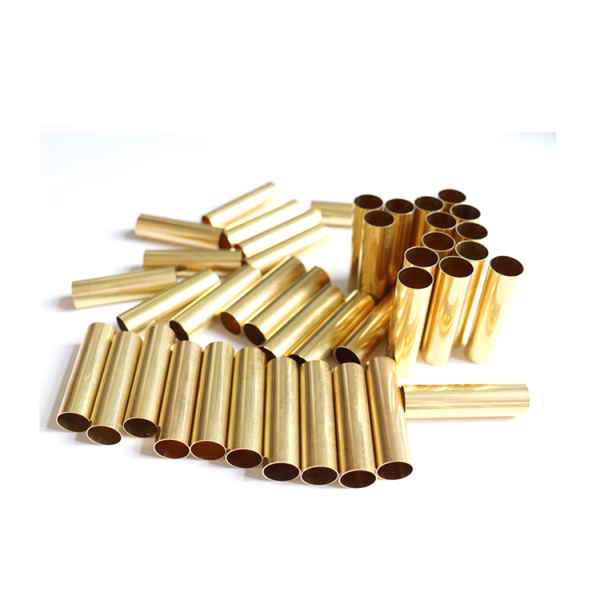
The development of copper alloy smelting technology has been a long process, but to this day, copper smelting is still primarily carried out using the smelting method. H65 brass wire | H62 brass capillary tubes | H59 brass bars | QSn6.5-0.1 tin bronze rods | imported tin bronze tubes | tin bronze plates account for approximately 85% of total global copper production.
In pyrometallurgical smelting, ore containing a few percent or a few thousandths of copper is first processed through beneficiation to increase the copper content to 20–30%, producing copper concentrate. This concentrate is then smelted in a closed blast furnace, reverberatory furnace, electric furnaces, or flash smelters to produce matte. The resulting matte (bluestone) is then sent to a converter for smelting into crude copper, which is subsequently refined in another type of reverberatory furnace through oxidative refining to remove impurities, or cast into anode plates for electrolysis, yielding electrolytic copper with a purity as high as 99.9%. This process is simple and highly adaptable, with a copper recovery rate of up to 95%; however, since the sulfur in the ore is emitted as sulfur dioxide exhaust gas during both the matte production and blowing stages, it is difficult to recover and can easily cause pollution.
In recent years, molten-pool smelting methods such as the Baiyin process and the Noranda process, as well as the Mitsubishi process in Japan, have emerged, and pyrometallurgical smelting has gradually shifted toward continuous and automated operations. Modern hydrometallurgical processes include sulfuric acid roasting–leaching–electrowinning, leaching–extraction–electrowinning, and bacterial leaching. These methods are suitable for heap leaching, tank leaching, or in-situ leaching of low-grade complex ores, copper oxide ores, and copper-bearing waste ores.
HAVE ANY QUESTION?